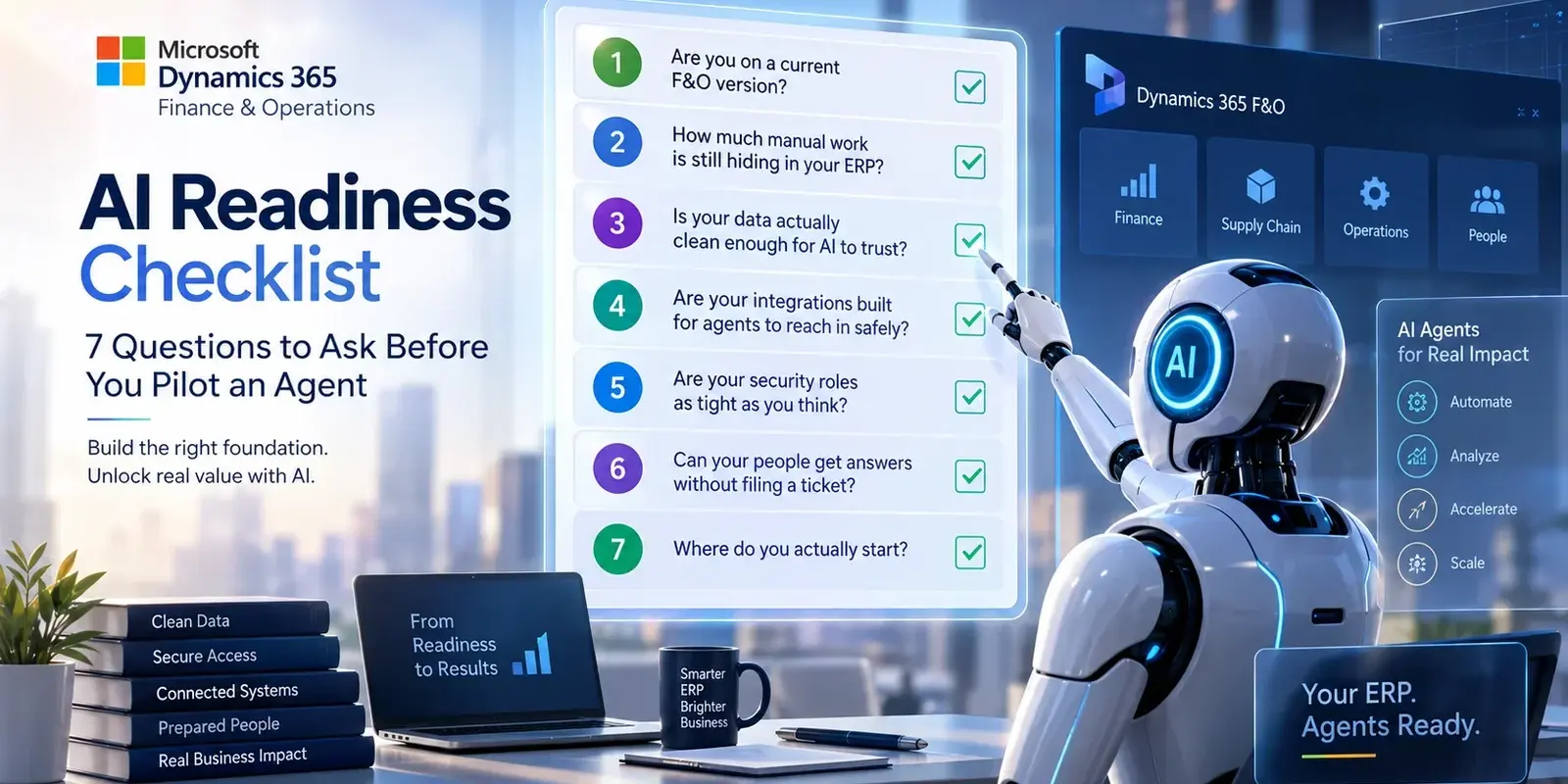
Before an agent can reconcile your accounts or answer finance questions in plain English, the environment underneath it has to be ready to hand over the keys. Most of the work is not in the agent. It is in everything the agent will touch.
Here is the checklist we run with Finance and Operations customers before a first pilot:
- Are you on a currently supported platform version?
- How much manual work is still hiding inside your ERP?
- Is your data clean enough for an agent to act on?
- Are your integrations built for an agent to reach in safely?
- Are your security roles as tight as you believe they are?
- Can your people get answers without raising a ticket?
- Do you know which process you would pilot first?
If any of those gave you pause, the rest of this is worth reading. If none did, you are further along than most of the teams we talk to.
Why this matters now
An agent does not fix messy data, undocumented customisations or loose security roles. It exposes them, at scale, in production. That is the difference between this and the automation waves before it: a scheduled job failed quietly at 2am, but an agent fails in front of a finance manager who asked it a question.
The gap between teams who mapped their foundation first and teams who switched everything on at once tends to show up inside a single quarter.
The seven checks, in detail
- Version currency. Newer agent capabilities assume you are reasonably current on platform updates. Several releases behind and you are not just missing screens, you are missing the plumbing those capabilities depend on.
- Manual work audit. Map where people still re-key data, match documents by hand, or export to a spreadsheet because a report cannot be trusted. That audit doubles as your pilot shortlist — it is a list of processes with a known cost.
- Data quality. Inconsistent ledger mappings, stale dimensions and incomplete history do not get smoothed over by an agent. They get amplified by one, because the agent acts on them instead of flagging them.
- Integration readiness. Agents can reach your data entities directly, but only where those entities, APIs and customisations are documented well enough to be safe to touch. Undocumented integration is the most common reason a pilot stalls.
- Security posture. An agent does not get its own identity. It operates inside the requesting user’s security role. Role drift you have been meaning to clean up stops being housekeeping the moment agents go live.
- Natural-language access. Ask your system a plain operational question right now — which vendors are overdue, which customers are slipping on terms. If the honest answer involves raising a ticket, that gap is exactly what a first pilot should close.
- A named first process. Pick by volume and pain, not by demo appeal. One contained process, measured before and after, tells you more than five half-finished ones.
Where does your environment stand?
Most teams already sense which item on this list would trip them up. Very few have written it down. The mapping itself is usually a matter of days rather than months, and it is considerably cheaper than discovering the answer during a rollout.