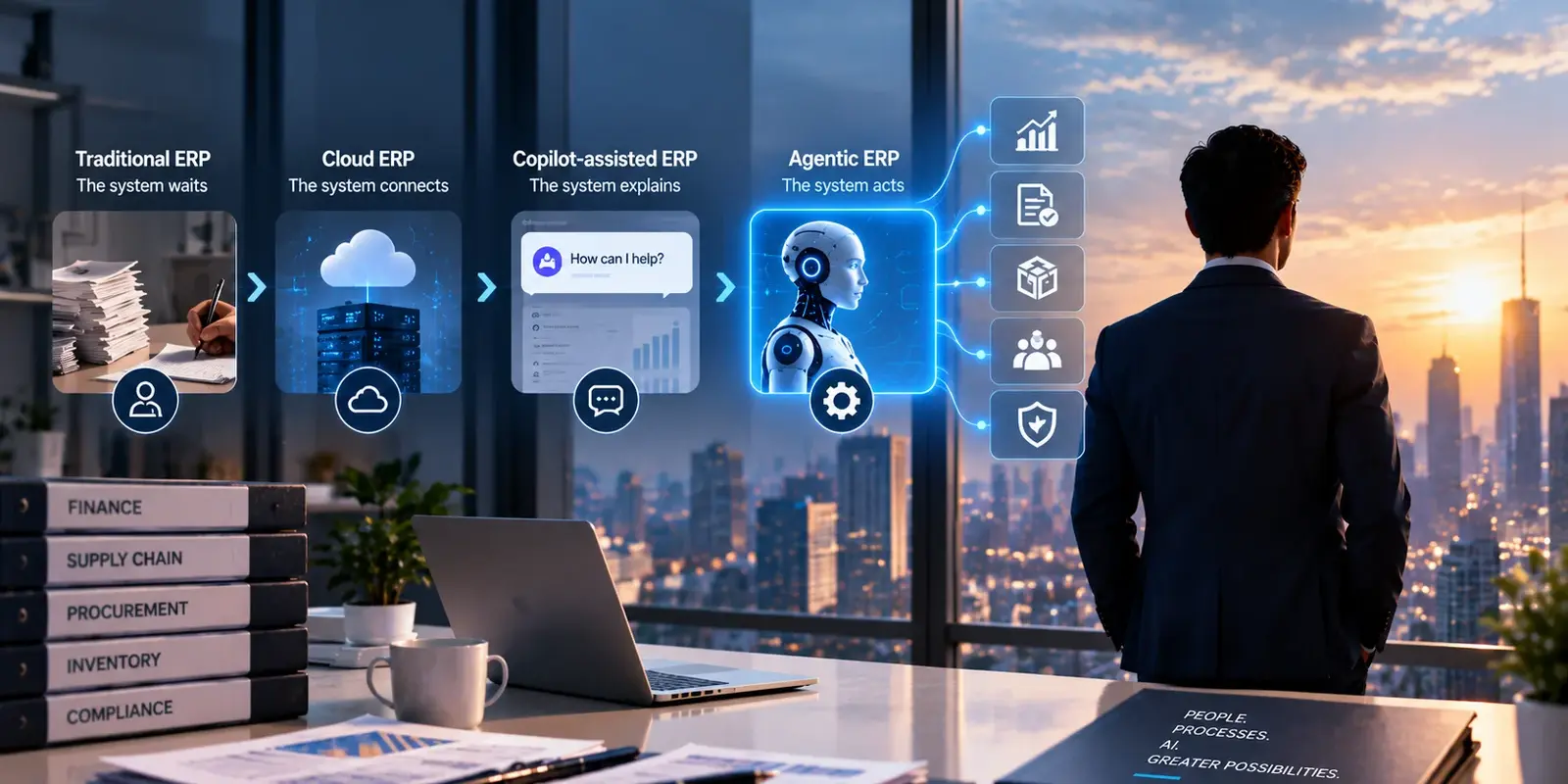
Every ERP rollout of the last three years has promised automation. What changes in 2026 is narrower and more interesting: the system starts acting rather than waiting to be driven.
That sounds like a marketing distinction. It is not. It changes who is accountable for a decision, and it changes what “implementing Dynamics 365” means for the people who run finance and operations.
1. How the system role has shifted
It is worth setting out the progression plainly, because each step changed who had to be present for work to happen.
- The system as container. You did something in the real world, then you recorded it. The ledger was a mirror held up after the fact.
- The system as connector. Cloud deployment brought elastic infrastructure and continuous updates. The operating model underneath stayed the same: a person, or a scheduled integration, still had to initiate everything.
- The system as commentator. Assistive AI arrived and could summarise, draft and answer. Genuine productivity, but the human stayed in the loop for every step.
- The system as actor. An agent is given an outcome rather than an instruction, and works within defined boundaries until the conditions are met.
2. What actually counts as an agent
The word is used loosely, so it helps to be precise.
An assistant is conversational and pull-based: you open it, ask a question, and it responds within that single interaction. An agent is push-based and persistent. It runs continuously or on a schedule, watches for defined conditions, and does not need the conversation reopened.
The difference from workflow automation is judgment. Traditional automation follows a fixed script: if X happens, do Y, every time, no exceptions. An agent handles a case nobody explicitly scripted for, because it is reasoning over the situation rather than matching it against a rule.
Three things have to be true before an agent is useful: it can reach the data behind the question, it can act inside the application, and it can explain what it did afterwards.
Remove any one of those and you have a demo rather than a deployment.
3. Why integration architecture became the bottleneck
None of this works if an agent cannot reach the ERP safely. That is the real constraint, and it is an architecture problem rather than an AI one.
An agent needs a documented, permissioned route to your data entities — one that exposes what it should reach and nothing else. Where that route exists, connecting an agent is straightforward. Where it does not, the work is the same integration and documentation work it has always been.
This is also why the security conversation cannot be deferred. An agent inherits the permissions of whoever invoked it, so a role that was over-broad but harmless when a person used it carefully becomes a genuine exposure when a system uses it at machine speed.
4. Where the value shows up first
The patterns that are working are unglamorous and high volume:
- Reconciliation. Matching subledger balances against the general ledger continuously instead of once a month, and surfacing only the exceptions.
- Purchase and order processing. Reading incoming documents, matching them against the order and receipt, and routing only the mismatches.
- Vendor and inventory monitoring. Watching performance against agreed criteria, or stock against thresholds, and starting the next step rather than waiting for someone to notice.
- Exception management. Pulling the handful of items that actually need judgment out of the pile that does not.
The shape is consistent: the agent handles the volume, the person handles the exceptions. Very few of these require new headcount decisions, which is part of why they land.
5. What to have in place first
Almost everything that stalls a rollout is on this list, and none of it is about AI:
- Clean, consistently mapped master data.
- Security roles that reflect what people should actually reach.
- Documented integration boundaries and data entities.
- Well-defined business processes — an agent cannot follow a process nobody has written down.
- An owner. Someone in the organisation has to be accountable for what agents are allowed to do.
Get those five right and agentic ERP is a genuine step forward. Skip them and you are automating the problems you already had, faster.
6. What comes next
The direction is clear even if individual features are not. The platform is moving from a curated set of capabilities toward a model where nearly any form, entity or business function can be reached by an agent, governed by the boundaries you set.
The organisations that get real value out of this will be the ones who turn on every available capability. They will be the ones who use the shift to clean up their processes, tighten their security model, and work out where human judgment genuinely belongs.